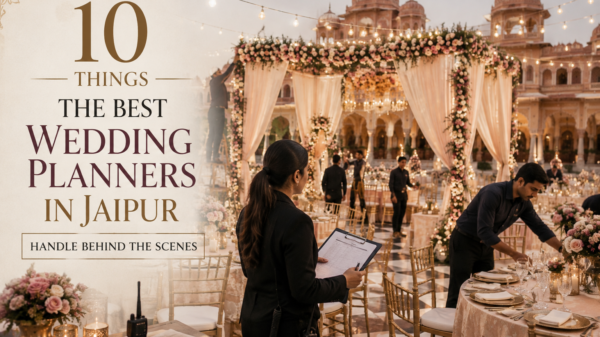
How to choose the right one: fees, contracts, red flags and the questions to ask before you pay anyone an advance
Picture two couples. Both book the same palace in Jaipur, for the same dates, with the same number of guests. One couple enjoys every minute of their wedding. The other spends three days on the phone, chasing a missing shuttle, a late mandap and a caterer who ran short of food at the sangeet.
The venue was the same. The planner was not.
Most couples spend weeks comparing palaces and about ten minutes comparing planners. It should be the other way round. The palace gives you the backdrop. The planner decides whether three days run smoothly or fall apart at the first delayed flight.
Jaipur makes this choice harder than it looks. Hundreds of people here call themselves wedding planners, from one-person decor setups to full teams that run 500-guest weddings across four hotels. Their websites look almost the same. Their prices do not. And most couples find out the difference only after they have paid the advance.
So here is the guide we wish every couple read first. We run one of the destination wedding planners in Jaipur, and we have still tried to write this the way a neutral friend would. Use it to judge us as strictly as you judge anyone else.
So, what does a wedding planner in Jaipur actually do?
The word “planner” covers very different jobs. Many couples are not unhappy with a bad planner. They hired the wrong kind of service and expected it to do everything. Here is who does what:
- A full-service wedding planner looks after your budget, venue shortlist, vendors, guest logistics, the schedule for every function and the on-ground team. They do not own the venue, and they cannot control the weather.
- A venue wedding coordinator handles everything inside their own property: rooms, banquet, food and timings. They usually do not look after your outside vendors, guests in other hotels or your overall budget.
- A decorator or event company builds the stage, mandap, florals and lighting. Guest management and the rest of the vendor chain are not part of the job.
- A travel agent or DMC takes care of flights, transfers and sightseeing, not rituals, food or the wedding schedule.
- A day-of coordinator runs the wedding day from a plan you give them. They do not do the months of planning and negotiation before it.
For a destination wedding, the full-service planner is the one that matters. The hard part of a Jaipur wedding is rarely decor. It is moving 150 people from three cities into four hotels, feeding them for three days with different dietary needs, and keeping six vendors on one timeline while the family is busy being emotional. That is logistics work, and it is the real product you are paying for.
Do you really need one? An honest answer
Not every wedding does. Here is a fair way to decide.
You probably need a planner if you have more than 80 to 100 guests, if guests are coming from outside Jaipur, if the wedding runs for two or three days, if you live in another city or country, or if two families with different traditions need both sets of rituals done properly. A palace or large hotel booking, where room counts and outside vendors need negotiation, is another strong reason.
You may manage without one if you are planning around 30 to 40 people at a single hotel, the venue has a strong in-house team whose fixed menu and decor options suit you, and a family member in Jaipur has the time and contacts to run things for weeks.
Even then, a one-time consultation can save you money on room blocks and vendor rates. If you are unsure which side you fall on, a free 60-minute chat with any planner is a fair test.
When to hire: earlier than you think
The most common mistake is hiring the planner after the venue is booked. By then the best moment to negotiate has gone. A good planner helps you shortlist, visit and negotiate before you pay a booking amount. Peak-season dates at the top palaces can be booked 12 to 18 months ahead, so your clock starts earlier than you expect. If you are still choosing dates, our month-by-month guide to getting married in Jaipur will help.
A realistic timeline looks like this:
- 12 to 18 months before: hire the planner, fix the budget range and guest estimate, shortlist 3 to 5 venues and lock the date.
- 9 to 12 months before: book the venue, negotiate room blocks, book the photographer and decide the decor concept.
- 6 to 9 months before: send save-the-dates, plan guest travel and hotels, finalise functions and entertainment direction.
- 3 to 6 months before: approve decor mock-ups, finalise invitations, confirm the baraat plan and permissions, and fix backup spaces for outdoor events.
- 2 to 3 months before: menu tasting, final guest list with digital RSVPs, transport and shuttle plan locked.
- Last month and last week: a detailed schedule for every function, vendor briefings, final payments tracked against the budget, and welcome desks and room lists checked.
How wedding planners charge (and where couples get caught)
Fees vary a lot, and the headline number tells you very little. What matters is the model, what is included, and whether the planner earns anything from vendors on the side. You will meet four models.
Flat fee. One fixed amount for a defined scope. It is easy to compare, and the planner has no reason to push you towards costlier vendors. The catch: extra functions or guests can trigger add-ons, so the scope must be written clearly.
Percentage of the budget. The fee grows with the wedding spend. It can work for very large, complex events. The catch is obvious: the planner earns more when you spend more, so ask how they protect you from that.
Hybrid. A smaller flat fee plus a percentage or a per-function charge. It balances effort and scale, as long as the percentage part has a ceiling.
Vendor commission. A low or zero visible fee, with the planner earning from vendor margins. It looks cheap on page one, but the margin can be buried inside vendor quotes, and you may never see the real rate.
Margins on vendors are not automatically wrong. Planners bring volume to vendors and negotiate rates, and some keep a share of that. The problem is hiding it. Ask one direct question: “Do you earn any commission or margin from vendors, and will it be shown in writing?” An honest planner answers in a sentence. A nervous one changes the subject.
For reference, our own planning fee runs from ₹1.5 lakh to ₹15 lakh depending on the plan, and it is always separate from venue, catering, decor and vendor costs. Each plan is explained in our Jaipur wedding planning packages. Whoever you choose, ask for the all-in budget estimate before the first payment, not after.
Nine things to check before you hire anyone
Use these in every meeting. They are in the order we would care about them if we were the couple.
Have they done weddings at your kind of venue?
Planning a wedding at a 245-room hotel and at a 40-room palace are different jobs. At a palace, guests are often spread across other hotels, so shuttles and timings carry more weight. At a large hotel, the challenge is keeping several functions and a big guest list on one timeline. Ask the planner to name weddings at your shortlisted venue, and to describe one thing that went wrong there and how they fixed it. We have planned 50+ weddings at Rambagh Palace, and the way we run them is explained in how we plan weddings at Rambagh Palace.
How to check: ask for venue names, guest counts and dates. Then ask the venue’s sales team, politely, whether they know the planner.
Will you get a written budget in week one?
A budget that exists only in conversation will change. A good planner gives you a line-by-line sheet in the first week and updates it as quotes arrive, with accommodation, catering, decor, photography, entertainment and logistics shown separately. As a rough guide, accommodation takes around 40% of a destination budget, catering 25%, decor 15%, photography and entertainment 10%, and logistics 10%. Your split will differ, but a planner who cannot explain their own split is guessing. Our destination wedding cost in Jaipur guide shows how this plays out by guest count.
How to check: ask for a sample budget sheet from a past wedding, with the client name removed.
Who will actually be at your wedding?
This is the most ignored question, and one of the most important. In some companies the person who sells you the wedding is not the person who runs it. Ask for the name of the lead planner, the on-ground manager and the coordinators for each day, and what happens if the lead is unavailable. At our end, Amitesh Fauzdar stays on site, and you can read about the team on the about page.
How to check: look for the on-ground team size in the proposal. For a 150-guest, three-day wedding, 8 to 12 coordinators is a reasonable range.
Is the rain plan written down?
Jaipur weather is kind for most of the wedding season, but outdoor functions still need a Plan B. Ask where the sangeet moves if it rains, who decides, how long the switch takes and who pays. A real example of this handled calmly is our story on saving an outdoor wedding when rain hit.
How to check: the plan should name the alternate space, the decision time and who bears the cost. “Don’t worry, we will manage” is not a plan.
Who are their vendors, and how are they priced?
A planner is only as good as the people they can call at 11 pm. Ask which caterers, decorators, photographers and artists they work with regularly, and whether you can see work from them. Ask whether vendor rates are shared with you or only the final package price. If you want to see how we handle individual services, they are laid out on our pages for catering, photography and videography and entertainment.
How to check: get two quotes for the same service, one through the planner and one direct, and compare what is included.
Do they have a system for guests?
Destination weddings fail on small things: the grandmother who waited an hour at the airport, the family given a room far from the lift, the shuttle that ran late. Ask the planner to walk you through what happens before guests arrive, on arrival day and during the wedding. The answer should include RSVPs with dietary and room preferences, room allocation, pickup lists, welcome desks and a fixed shuttle schedule. If they only talk about decor, they have not run many destination weddings.
How to check: ask to see a sample guest itinerary or arrival sheet.
Do they communicate the way you like?
You will talk to this team daily in the last month. Agree early on how: one WhatsApp group, a weekly call, a shared drive, one point of contact. If you live abroad, ask whether calls can happen in your time zone and whether updates come in writing.
How to check: note how fast they reply before you sign. The first week is usually the best behaviour you will ever see.
Can you verify their references?
Testimonials on a website are easy to write. Look for reviews on independent platforms such as WedMeGood and WeddingWire, and ask for two past clients you can speak to. Read full wedding stories, not just highlight photos, because stories show the challenges and how they were solved. Our real wedding stories are published for exactly this reason.
How to check: call one reference and ask two things: “What went wrong?” and “Would you hire them again?”
Does the contract say what was promised?
If it is not in the contract, it will be forgotten or disputed. This one has its own section further down.
21 questions to ask in your first meeting
Keep these on your phone. You do not need all of them. Pick the ones that matter most for your wedding.
About their experience
- How many destination weddings have you planned in Jaipur, and how many at my shortlisted venues?
- Which wedding was the most difficult, and what went wrong?
- Have you planned weddings for my community and my family’s rituals?
- How many weddings do you run in the same week during peak season?
- Can I speak to two past clients?
About money
- What exactly does your fee include, and what is extra?
- Do you earn any commission or margin from vendors, and will it be shown to me?
- What are the payment stages, and what happens to my advance if I change the date?
- How do you handle GST, service charges and overtime in the budget?
- What are the most common extra costs couples face, and which are likely for us?
About the team
- Who will be my main contact, and who will be on the ground during the wedding?
- How many coordinators will be present on each day?
- Do you have a second lead if the main planner is unavailable?
- Do you work only with your own vendors, or can I bring mine?
About guests and logistics
- How will you manage guests staying in more than one hotel?
- How do you handle elderly guests, children and special diets?
- What is your shuttle and airport pickup system?
- How do you deal with last-minute guest additions?
About things going wrong
- What is your plan if it rains during an outdoor function?
- What happens if a key vendor cancels a week before the wedding?
- How do you tell the family about a problem on the wedding day, and who decides what to do?
Ten red flags that should make you pause
One red flag can be explained. Three together are usually a pattern.
- No written quote. Everything is “we will see later” or “we will adjust”.
- A low fee with a very high package price. The money has simply moved somewhere you cannot see.
- Pressure to pay quickly. “The date will go” is sometimes true, but a good planner still gives you time to read the contract.
- Only decor photos, no proof of guest handling. This often means a decorator calling itself a planner.
- Vague answers about who attends. If you cannot get names, you will not get accountability.
- Refusing to share vendor names or rates. You are paying for access, not secrecy.
- Guaranteed outcomes. Nobody can guarantee weather or a date that a palace has not confirmed.
- No backup plan for outdoor events, especially baraat, sangeet or open-lawn functions.
- Reviews that all sound the same. Real reviews mention specific people, places and problems.
- Criticising every other planner. Confidence is quiet. Constant comparison usually hides weak proof.
The best planners are not the ones with the longest portfolio. They are the ones who can tell you, calmly, what will go wrong at your venue and what they will do about it. |
Read the contract before you read the brochure
A planner’s proposal is not just a price. It is a promise, and promises need words. Before you pay an advance, check these clauses.
Clause | What it should say | Why it matters |
Scope of work | List of functions, guest count, services included and excluded. | Prevents “that was not part of the package” later. |
Payment schedule | Amounts, dates and what each payment unlocks. | You should not pay the bulk before key bookings are made. |
Cancellation and date change | What is refunded, what is not, and who bears vendor penalties. | Weddings do get postponed. This tells you the cost. |
Vendor contracts | Whether vendors are booked in your name or the planner’s name. | Decides who can claim a refund or hold a vendor responsible. |
Taxes and charges | GST, service charge, overtime, generator and permits shown separately. | Hidden costs can add up to a large part of the budget. |
Named team | Lead planner, on-ground manager and number of coordinators for each day. | Locks in the people you were sold on. |
Backup plan | Alternate space for outdoor events, decision time and who pays. | Turns a bad-weather day into a managed day. |
Changes and overtime | How guest increases, menu changes and late-night extensions are priced. | Stops last-minute surprises with a premium attached. |
Deliverables | What you receive after the wedding and by when: photos, films, settlement of accounts. | Closes the loop. |
On taxes in particular, a service charge on food and beverage plus GST on venue and services can add a big amount on top of a headline quote. We list these on our main page for wedding planners in Jaipur, and the same checks apply whoever you hire.
Palace, hotel or haveli? Your venue changes the job
Jaipur offers palaces, large luxury hotels and boutique havelis. Each asks for a different kind of planning skill, so ask your shortlisted planners how they would handle your type.
Heritage palaces such as Samode Palace or Chomu Palace give you a strong visual setting, fewer rooms and a limited number of weddings at a time. Your planner needs to handle guests spread across more than one hotel, shuttle timings, decor that works with the architecture, and a rain plan for lawns and courtyards.
Large luxury hotels such as Fairmont Jaipur or ITC Rajputana give you big room inventory, several banquet spaces and polished in-house service. Here the planner’s job is using the room count well, keeping several functions on one timeline, and checking whether other events are running on your dates.
Boutique havelis are intimate and beautiful, but space is tight. Vendor access and loading, noise and timing limits, and guest transport to nearby stays need more thought than you would expect.
There are local questions too, and a good planner answers them before you ask. Which permissions does a baraat on that route need? Who applies for music, drone or fireworks permission? What is the music cut-off for outdoor functions at your venue? Does the venue charge a fee for outside vendors, or insist on its own? Some palaces keep preferred vendor lists, so ask the planner to confirm this with the property in writing. To compare properties first, start with our wedding venues in Jaipur page or the palace venue comparison.
Planning from abroad? Here is what to expect
Many couples who choose Jaipur live in London, Toronto, Dubai, Sydney or New York. If that is you, your planner has to be strong at remote work. We explain the reasoning in why NRI couples choose Jaipur for their wedding and the working method in our guide to NRI wedding planning in Jaipur. At a minimum, you should get:
- Video consultations in your time zone, not only Indian office hours.
- Live or recorded virtual tours of every venue on your shortlist.
- A shared budget tracker and drive that both families can open.
- An INR payment plan with clear dates, so you can plan transfers and exchange rates.
- Help with guest flights, visa letters and arrival coordination for relatives travelling from overseas.
- A recommendation to reach Jaipur at least three days before the first function.
One more thing on paperwork. Marriage registration is a separate legal step from the ceremony, done under the Hindu Marriage Act or the Special Marriage Act depending on the couple. A good planner can guide you on documents and appointments, but read the official rules on the India Code portal and confirm requirements with the local registration office. For first-time guests visiting Jaipur, the Rajasthan Tourism website is a reliable place to start.
Do they understand your family’s rituals?
Decor can be copied from Instagram. Rituals cannot. A Marwari, a Punjabi and a Gujarati wedding have different sequences, different people responsible for different steps, and different moments where timing matters. A planner who has run your style of wedding knows when the pandit needs to arrive, what the family will forget to bring and how long a ceremony really takes.
Ask for experience in your tradition specifically. We plan Marwari weddings and Punjabi weddings often, and the full list of traditions we handle is on our wedding types page. If your wedding blends two traditions, ask how they would sequence the functions so neither family feels like a guest at the other’s wedding.
How a good planner talks about money
A planner who is comfortable with numbers brings up the uncomfortable parts first. In the first budget meeting they should walk you through the costs that surprise most couples: service charge on food, GST, overtime after the venue cut-off, extra power for lighting and sound, overflow hotels if the venue is short of rooms, and shuttles between hotels. Planners who skip these in the first meeting usually reveal them in month ten.
Good planners also show you where to save without making the wedding look smaller. Shoulder-season dates, lunch functions instead of dinners, weekday dates, palace architecture with good lighting instead of heavy sets, and fewer functions are the usual levers. For the full picture, read our Jaipur wedding cost guide.
A simple test Ask each planner: “Where would you cut ₹5 lakh from this budget without guests noticing?” A planner who thinks about your money answers in seconds, with examples. One who does not will say “we can adjust anywhere.” |
Mistakes we see couples make
- Choosing on price alone. The cheapest quote often leaves out items the next planner includes. Compare scope, not totals.
- Hiring after the venue is booked. You lose the chance to negotiate rooms and rates together.
- Never meeting the on-ground team. The pitch is delivered by one person. The wedding is delivered by another.
- Letting everything live on WhatsApp. Important decisions should also sit in a shared document.
- Keeping the guest list vague for too long. Every late change hits rooms, food and transport.
- Skipping the tasting and the decor mock-up. These two meetings prevent most last-week arguments.
- Forgetting permissions. A baraat route or a late-night sangeet can be stopped by a missing approval.
What the first 30 days after hiring should look like
A good planner starts moving quickly. If a month has passed and all you have is a signed contract, something is wrong. By day 30 you should have:
- A kickoff call that confirmed functions, guest count, traditions, budget range and priorities.
- A written scope and a budget sheet that both sides have seen.
- A venue shortlist with site visits scheduled, in person or virtual.
- A shared drive, a communication group and one point of contact.
- A tentative timeline for the next three months, with a date for each decision.
- A date locked or held with your preferred venue, with the hold period written down.
How we work at Weddings and Events by Amitesh
Since we have asked you to judge planners strictly, it is only fair to show how we measure up. Our team has 12+ years of experience and has planned 200+ weddings across Jaipur and Rajasthan, including more than 50 for NRI couples. Every client gets a written budget in the first week, direct access to Amitesh without middlemen, and an on-ground team of 8 to 12 coordinators on the wedding days.
Our plans range from ₹1.5 lakh to ₹15 lakh depending on guest count and scope. You can compare each one in our packages, or read the full service overview on our destination wedding planner in Jaipur page. If you want to see a finished wedding before you speak to anyone, our wedding stories show real couples, real challenges and what we did about them. We also plan beyond Jaipur, including Udaipur.
And if you already have a proposal from another planner, send it across. We will tell you honestly what looks fair and what does not, whether or not you hire us.
Before you sign: a quick checklist
- You have met the person who will actually run your wedding.
- You have a written scope, a budget sheet and a payment schedule.
- You know how the planner earns, including any vendor margins.
- You have heard the backup plan for rain and for a vendor cancellation.
- You have spoken to at least one past client.
- The planner has handled your venue type and your family’s traditions before.
If you can tick all six, you are in good hands. If not, keep asking until you can. This is the one decision in your wedding where a little extra suspicion pays off.
When you are ready to talk, book a free consultation with our team or read more guides on the Weddings and Events by Amitesh blog.
Frequently Asked Questions
For peak-season dates between November and February, start 12 to 18 months ahead. Top palaces fill early, and early involvement helps with negotiation. For shoulder-season dates and a smaller guest list, six to nine months can work, but your venue choices will be narrower.
It depends on the model and scope. Our own fees run from ₹1.5 lakh to ₹15 lakh across plans, and venue, catering and decor are paid separately. When comparing planners, compare what each fee includes, not only the amount. See our packages page for plan details.
A flat fee is easier to compare and does not reward higher spending. A percentage can be reasonable for very large weddings if it has a ceiling. Whichever you pick, get the scope and the cap in writing.
Yes, and many couples do. But you lose the chance to negotiate room blocks and terms together. If the venue is already booked, ask the planner to review the venue contract before you pay anything further.
It depends on the company. Ask for named people, not only roles. For a mid-sized wedding, expect a lead planner, an on-ground manager and a team of coordinators across the functions.
They can guide you on documents and timing, but registration is a legal step the couple completes with the relevant authority. Confirm the current rules on the official portal or at the local registration office.
Often yes, but ask in advance. Some planners charge a coordination fee, and some venues restrict outside vendors. Make responsibilities clear in writing, especially if an outside vendor fails to deliver.
A good planner already has an alternate space, a decision time and a cost owner agreed in the contract. Ask to see this before you sign. Our story on handling rain at an outdoor Jaipur wedding shows how it works in practice.
Yes. Many couples do it with video consultations, virtual venue tours, a shared budget tracker and a planner who handles the on-ground work. Read our NRI wedding planning guide for the full process.