Sutra Model is a ‘mathematical model’ for pandemics that have asymptomatic patients. The acronym stands for Susceptible, Undetected, Tested (positive), and Removed Approach (SUTRA). There are several novel features of the proposed model, according to a study.
The patient population are divided into Asymptomatic and Infected, which explicitly accounts for the fact that, due to contact tracing, a fraction of asymptomatic patients could also be detected. In addition, there would also be large numbers of undetected asymptomatic patients. It presents numerically stable methods for estimating the parameters in the model.
The model is applied to predict the progression of the COVID-19 pandemic. Where data on the number of recovered patients is available, the number of active cases as a function of time is predicted. Where recovery data is not available, the number of daily new cases is predicted.
So basically, the SUTRA model is used for charting the trajectory of COVID-19 in the country. In a media statement, a group of scientists working on the model stated that a mathematical model can only predict the future with some certainty so long as virus dynamics and its transmissibility don’t change substantially over time. They added that in the case of COVID-19, the nature of the virus has been changing very rapidly.
What is happening?
Recently, some media reports suggested that scientists working on the SUTRA model cautioned in March about the second wave but attention was not paid to it. However, the scientists working on the SUTRA model for charting the trajectory of COVID-19 clarified that some facts related to predictions of the mathematical model have been misunderstood and misquoted.
They further say, “ A meeting was called on 2nd April to seek our inputs by one of the very senior officers of the government coordinating the national pandemic response. We indicated that the SUTRA model predicted the second wave to peak by the third week of April and to stay most likely around 1 lakh daily cases.”
“Clearly, the model predictions in this instance were incorrect because of the reasons below. We have been working on a mathematical model to predict the spread of the virus. It is important to note that a mathematical model can only predict future with some certainty so long as virus dynamics and its transmissibility don’t change substantially over time. Mathematical models can also provide a mechanism to predicting alternate scenarios corresponding to various policy decisions such as non-pharmaceutical interventions.
In the case of COVID-19, it is clear that the nature of the virus has been changing very rapidly. In such a context, any prediction for COVID-19 must be continually readjusted, sometimes almost daily.”
“We are working closely with the government and our inputs have always been received positively. While we could not predict the exact nature of the second wave earlier, we continue our efforts to better estimate its future trajectory.” Manindra Agrawal, Professor, IIT Kanpur, Madhuri Kanitkar, Deputy Chief, Integrated Defense Staff, M Vidyasagar, Professor, IIT Hyderabad said in a press release.
Few questions which arise at such critical conjecture are: If the scientist working informed the govt that the second wave would peak in ‘April third week,’ why didn’t the govt take early steps? Could the government have been more alert looking at the predictions?
The predicted mark of April third week was already 1,03,558 new infections on April 6, two weeks ahead of the prediction.
On April 3rd India reported 86,184 new COVID cases, 471 new deaths and 58,523 fresh recoveries, with an active caseload of 6,82,202 patients. The figures does not include data from Chhattisgarh, Assam, Jharkhand and Ladakh U.T. The data is sourced from covid19india.org, an independent aggregator of daily COVID-19 figures.
What went wrong? Was the government too busy conducting election rallies?
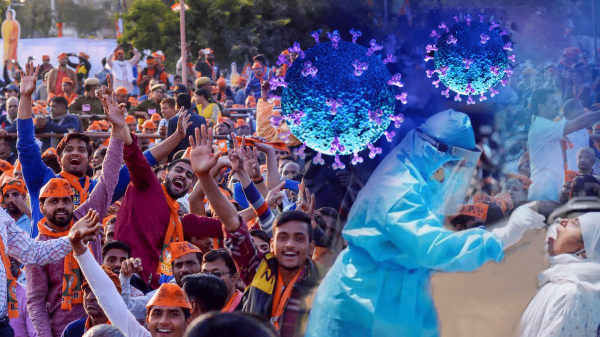
On one side where the country was battling with the second wave, the other side government-held massive rallies in poll-bound states. Why did the government ignored the early warnings and continued with the mega rallies themselves?
Did the government fail to take cognizance that cases could surpass the predicted 1 lakh cases seeing the virus transmissibility?
Did the government take the predicted 1 lakh cases mark lightly? What measures should have been taken depending on the transmissibility of the virus?
The question remained unanswered.